


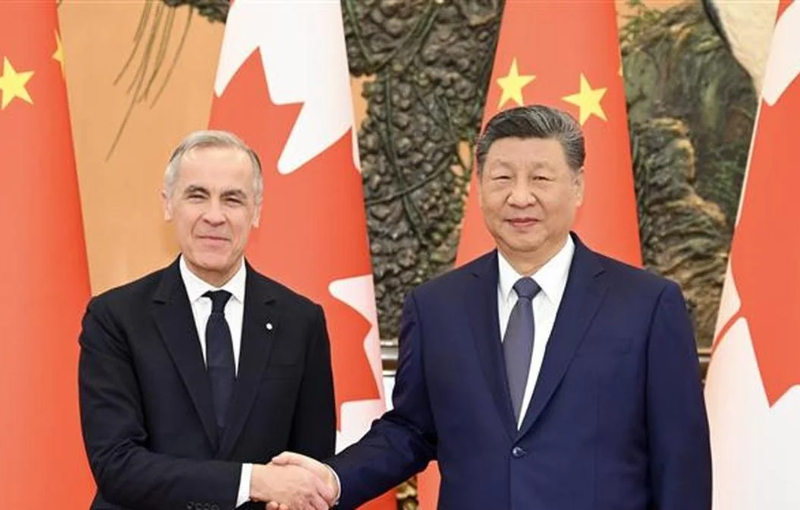
Canada China Trade Deal Canada and China have agreed to expand their bilateral trade arrangement following a meeting between Canadian Prime Minister Mark Carney and Chinese President Xi Jinping in Shenzhen, opening additional opportunities for Canadian agricultural producers, seafood exporters and businesses seeking access to the Chinese market.
The announcement, made on November 17, 2026, extends an existing preliminary trade arrangement and introduces additional tariff relief covering approximately C$400 million in Canadian exports. The latest measures include frozen pork, Greenland halibut, selected shrimp and prawns, molluscs and sea cucumbers.
The agreement also includes reciprocal steps from Canada, which will extend existing tariff-remission measures for certain Chinese steel and aluminium products for another two years and expand coverage to additional tariff items.
The development represents another step in the rebuilding of economic relations between the two countries after several years of trade restrictions and diplomatic tensions.
For Canadian businesses, the expanded Canada China trade deal could provide improved access to one of the world’s largest consumer markets. It also creates opportunities in agriculture, seafood, financial services, energy, education and digital commerce.
However, the closer relationship comes with political and economic considerations, particularly around national security, Chinese investment, domestic manufacturing and Canada’s relationship with the United States.
Punjab Lens Media examines what Carney and Xi agreed to, which industries could benefit and what the expanded trade arrangement means for Canadian businesses.
Carney and Xi Expand Canada-China Trade Arrangement After Shenzhen Meeting
The latest development follows a meeting between Mark Carney and Xi Jinping in Shenzhen, China, on November 17, 2026.
The leaders agreed to extend and expand the Preliminary Joint Arrangement on Addressing Bilateral Economic and Trade Issues, building on the strategic partnership launched earlier in 2026.
The arrangement is intended to reduce trade barriers and improve access for businesses operating between the two countries.
Under the expanded measures, China will provide additional tariff relief for approximately C$400 million in Canadian exports. The affected products include most frozen pork cuts, certain frozen cold-water shrimp and prawns, including Pacific spot prawns, selected molluscs such as geoduck, sea cucumbers and Greenland halibut.
The announcement also builds on earlier tariff-relief measures covering Canadian canola meal, peas, lobster and crab.
In exchange, Canada agreed to extend existing remission measures for certain Chinese steel and aluminium products until December 31, 2028. Coverage will also expand to 32 additional tariff items, including 23 steel and nine aluminium categories where Canadian supply is insufficient or unavailable.
The arrangement is an extension of an existing preliminary trade framework, not a comprehensive Canada-China free trade agreement.
According to the Canadian government, more than 90% of Canadian trade previously affected by tariff action has now regained market access.
The expanded Canada China trade deal therefore represents a significant change in bilateral trade conditions, although the longer-term relationship will depend on implementation and continued cooperation.
Why Is Canada Strengthening Trade Relations With China?
Canada’s decision to expand economic cooperation with China is closely connected to its broader strategy of diversifying international trade.
The United States remains Canada’s largest trading partner, but uncertainty surrounding international tariffs and trade restrictions has increased pressure on Canadian businesses to develop alternative export markets.
China offers access to a large consumer market and demand across several Canadian industries, including agriculture, seafood, energy and natural resources.
The Canadian government has set an ambitious target of increasing exports to China by 50% by 2030.
The latest measures are designed to support that objective by improving market access, reducing tariff uncertainty and encouraging additional commercial relationships.
In 2025, bilateral merchandise trade between Canada and China reached C$125.6 billion, representing a 5.6% increase compared with 2024. China accounted for C$35.1 billion in Canadian merchandise exports during the same year.
The expanded trade arrangement also forms part of Canada’s wider Indo-Pacific strategy, which aims to create stronger economic relationships across Asia.
For Canadian exporters, the Canada China trade deal offers an opportunity to reduce dependence on a limited number of markets and build additional international revenue streams.
However, trade diversification does not mean replacing the United States as Canada’s primary commercial partner. It means creating more options for Canadian companies when international market conditions change.
Canadian Agriculture and Seafood Exporters Could Gain New Opportunities
Agriculture and seafood are among the sectors most directly affected by the expanded trade arrangement.
Canadian producers have faced difficulties accessing the Chinese market during periods of trade disputes and tariff restrictions. The latest measures are intended to restore additional market access and improve conditions for exporters.
The new tariff relief covers several products with established export markets in China.
Frozen pork cuts are included in the expanded arrangement, with approximately C$116 million in exports identified by the Canadian government as the relevant historical trade value.
Seafood products covered include Greenland halibut, selected frozen shrimp and prawns, geoduck and sea cucumbers. The government estimates the affected seafood export categories at approximately C$285 million.
These measures could provide additional opportunities for Canadian food producers, processors, fishing businesses and exporters.
The earlier trade arrangement has also helped restore market access for canola seed, canola meal, peas, lobster and crab.
According to Global Affairs Canada, exports of Canadian canola seed to China reached C$1.74 billion between March and August 2026, an increase of approximately 43% compared with the same period in 2025.
Canadian canola meal exports to China reached C$327.5 million during that period, while pea exports reached C$347 million.
These figures demonstrate why improved access to China matters to agricultural producers, particularly in Western Canada.
For Prairie farmers, exporters and businesses connected to agricultural processing, the Canada China trade deal could help improve market access and reduce some of the uncertainty associated with previous trade restrictions.
However, actual benefits will depend on demand, shipping arrangements, regulatory requirements and the continued implementation of tariff measures.
What Does the Trade Arrangement Mean for Canadian Businesses?
The expanded partnership goes beyond agricultural exports. Both governments have identified additional opportunities in digital commerce, financial services, education, energy and commercial investment.
One of the major announcements is the designation of 2027 as the Canada-China Year of e-Commerce.
The initiative is intended to help Canadian small and medium-sized businesses reach Chinese consumers through digital platforms and develop commercial relationships with Chinese businesses.
For smaller Canadian companies, access to international e-commerce channels could provide opportunities to expand without establishing a large physical presence in China.
The Canadian government has also announced a major trade mission to China in 2027. The mission is expected to connect Canadian businesses with Chinese industry leaders, potential customers and commercial partners.
Another development is the proposed Canada-China CEO Roundtable, which is intended to strengthen business-to-business engagement between the two countries.
These initiatives could create opportunities for companies in manufacturing, consumer products, technology, education and professional services.
However, improved trade access does not automatically guarantee commercial success. Businesses will still need to navigate Chinese regulations, local competition, payment arrangements, intellectual property protection and market-specific requirements.
The Canada China trade deal could create additional opportunities, but companies will need to assess the commercial and regulatory risks before committing capital.
Could Chinese Investment in Canada Increase?
The improvement in bilateral relations could also influence investment flows between Canada and China.
The two governments have agreed to strengthen financial and regulatory cooperation, including engagement between financial authorities, monetary institutions and capital-market regulators.
Their discussions also covered financial services market access and the implementation of a bilateral currency-swap arrangement.
These developments could make it easier for financial institutions and businesses to explore opportunities in each other’s markets.
The Canadian government reported that China’s foreign direct investment stock in Canada stood at C$43.4 billion in 2025, making China the fourth-largest investor country in Canada. Canada’s direct investment stock in China stood at C$15 billion.
The improving relationship may create opportunities for further investment in areas such as energy, infrastructure, manufacturing and financial services.
However, Canada continues to maintain national security and investment-screening requirements.
Foreign investment proposals involving sensitive technologies, critical infrastructure, strategic industries or national security considerations may face additional scrutiny.
This means the Canada China trade deal should not be interpreted as an unrestricted opening for Chinese investment in Canada.
Businesses will still need to comply with Canadian laws and applicable investment review processes.
Energy Cooperation Could Open Another Area of Business Growth
Energy is another important part of the renewed Canada-China economic relationship.
The two countries have identified opportunities to strengthen cooperation in conventional energy, including oil and gas, as well as renewable energy, nuclear power and low-carbon technologies.
A Canada-China Ministerial Dialogue on Energy was held on November 3 and 4, 2026, bringing together Canadian industry representatives and major Chinese companies.
The discussions covered conventional fuel exports, uranium, nuclear services, renewable energy and potential investment opportunities.
The talks also explored possible equity investments and long-term offtake commitments.
For Canadian energy producers, China could represent an additional market for selected resources and energy-related services.
For Chinese companies, closer engagement could provide opportunities to explore Canadian energy projects and investment partnerships.
However, discussions and potential investment opportunities should not be confused with completed contracts or confirmed project financing.
The actual impact will depend on commercial agreements, infrastructure capacity, regulatory approvals and international energy-market conditions.
The energy component of the Canada China trade deal could become particularly important as both countries explore opportunities across traditional and emerging energy industries.
What Are the Political and Security Risks of Closer Canada-China Relations?
Despite the potential economic benefits, stronger trade relations with China remain politically sensitive in Canada.
The two countries have experienced periods of diplomatic tension involving trade restrictions, national security concerns, allegations of foreign interference and human rights issues.
These issues have not disappeared simply because both governments are seeking closer economic cooperation.
Canada must balance the benefits of expanded trade with concerns about protecting strategic industries, critical infrastructure, sensitive technologies and domestic manufacturing.
The automotive sector is one example of this challenge. Chinese electric vehicle imports and potential investment in Canadian manufacturing have generated debate about competition, industrial policy and supply-chain security.
The United States also remains an important consideration. Canada and the United States have deeply integrated manufacturing and supply chains, and developments in Canada’s relationship with China can influence broader North American trade discussions.
For Canadian policymakers, the challenge is to increase economic opportunities without creating excessive dependence on another major trading partner.
Supporters of the expanded arrangement argue that stronger trade relationships can create additional export markets and improve economic resilience.
Critics may question whether closer commercial ties could create new strategic vulnerabilities or expose Canadian businesses to political uncertainty.
The success of the Canada China trade deal will therefore depend not only on trade volumes but also on how both governments manage these wider concerns.
How Does the Canada China Trade Deal Fit Into Canada’s International Trade Strategy?
The expanded arrangement forms part of Mark Carney’s wider effort to diversify Canada’s international economic relationships.
The government has been pursuing stronger commercial ties across Asia, Europe and other international markets.
Canada has also been working on trade negotiations and investment partnerships with several economies to improve access for domestic businesses.
The objective is to create more export opportunities, attract international capital and reduce the risks associated with depending too heavily on a single market.
China’s position as the world’s second-largest economy makes it an important part of this strategy.
The expanded trade arrangement also creates a framework for cooperation beyond merchandise exports, including financial services, digital commerce, education, tourism and energy.
However, Canada-China trade relations will continue to be shaped by domestic political priorities, international security developments and the wider economic relationship between China and North America.
The Canada China trade deal is therefore one part of a broader effort to strengthen Canada’s international economic position rather than a standalone solution to its trade challenges.
What Happens Next After the Carney-Xi Trade Agreement?
The next stage will involve implementing the announced measures and turning the political commitments into practical commercial opportunities.
The expanded preliminary arrangement is scheduled to remain in place until December 2028.
Canadian exporters will be watching the implementation of tariff relief and whether the improved market access translates into additional orders.
Businesses will also be preparing for the 2027 trade mission to China and the Canada-China Year of e-Commerce.
The financial and energy dialogues could lead to further discussions between companies and government agencies, although specific commercial outcomes will depend on future negotiations.
Several developments will be important to monitor:
- Tariff implementation: Whether the announced reductions and exemptions are applied as scheduled.
- Agricultural exports: Whether Canadian pork, seafood, canola and other products record further growth in Chinese markets.
- Business investment: Whether new commercial partnerships and investment agreements emerge.
- Energy cooperation: Whether discussions result in concrete investment commitments or long-term supply contracts.
- Political relations: Whether Canada and China can maintain stable diplomatic and regulatory cooperation.
The coming months will help determine whether the expanded Canada China trade deal delivers lasting benefits for Canadian businesses.
Punjab Lens Media will continue following developments in bilateral trade, investment and international economic policy.
Frequently Asked Questions
1. What is the Canada China trade deal?
The Canada China trade deal refers to the expanded preliminary trade arrangement between Canada and China. Following Mark Carney’s November 17, 2026 meeting with Xi Jinping, both countries agreed to extend their existing framework and introduce additional tariff relief for selected Canadian exports.
2. What did Mark Carney and Xi Jinping agree to?
The leaders agreed to expand trade cooperation, improve access for Canadian agricultural and seafood exports, extend tariff arrangements and strengthen economic, financial, energy and commercial relationships.
3. Which Canadian products will benefit from the new tariff relief?
The expanded measures cover most frozen pork cuts, Greenland halibut, selected frozen shrimp and prawns, certain molluscs including geoduck, and sea cucumbers. Earlier measures also cover canola meal, peas, lobster and crab.
4. How much Canadian trade is covered by the expanded arrangement?
The November expansion provides additional tariff relief for approximately C$400 million in Canadian exports. The Canadian government says more than 90% of Canadian trade previously affected by tariff action has now regained market access.
5. Will Canadian farmers benefit from the Canada China trade deal?
Canadian agricultural producers could benefit from improved market access and reduced tariff barriers. Canola, peas and pork are among the products affected by the wider trade arrangement. Actual benefits will depend on demand, prices and export conditions.
6. Could Chinese investment in Canada increase?
Improved economic relations could create additional investment opportunities in energy, infrastructure, manufacturing and financial services. However, Canadian national security and foreign investment screening requirements will continue to apply.
7. Is the Canada China trade deal a free trade agreement?
No. The current arrangement is a preliminary bilateral trade framework that has been extended and expanded. It should not be described as a comprehensive Canada-China free trade agreement.
8. What is the Canada-China Year of e-Commerce?
It is a planned 2027 initiative designed to help Canadian small and medium-sized businesses access Chinese digital commerce platforms and develop additional export opportunities.
9. Why is Canada expanding trade with China?
Canada wants to diversify its export markets, attract investment and reduce its dependence on a limited number of trading partners. China offers a significant market for Canadian agriculture, seafood, energy and other products.
Conclusion: Canada and China Move Toward a More Active Trade Partnership
The expanded Canada China trade deal marks an important development in Canada’s international economic strategy, following the November 17 meeting between Mark Carney and Xi Jinping.
The additional tariff relief covering approximately C$400 million in Canadian exports could provide new opportunities for agricultural producers, seafood businesses and exporters. The planned 2027 trade mission and e-commerce initiative could also help Canadian companies explore the Chinese market.
At the same time, the agreement extends beyond traditional trade. Financial services, energy cooperation, investment, education and commercial exchanges are becoming important parts of the relationship.
However, the economic opportunities come with political and security considerations. Canada will need to maintain appropriate safeguards while managing its relationship with China and protecting its broader trade interests.
The real test will be whether the latest announcements lead to sustained export growth, stronger business partnerships and long-term economic benefits.
For continuing coverage of the Canada China trade deal, international business developments and Canada’s changing economic relationships, follow Punjab Lens Media at https://punjablensmedia.com/.