






Punjab Stubble Burning: 123 Farm-Fire Cases in One Day — Why Do Farm Fires Spike Every October?
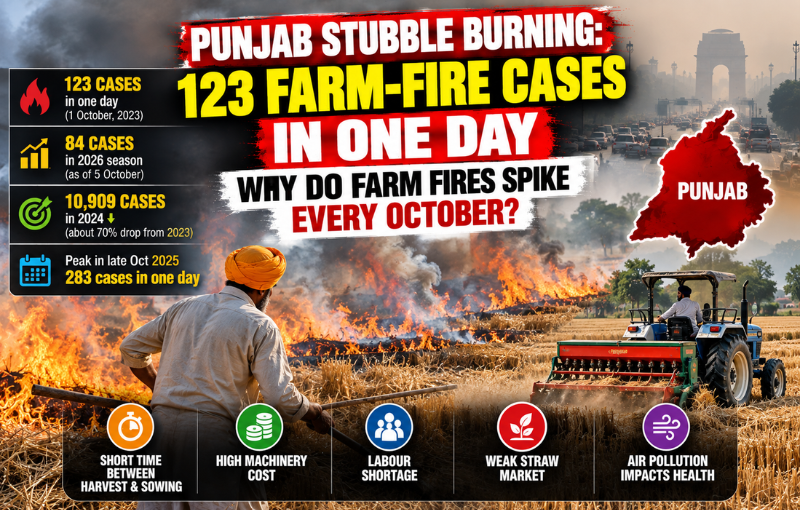
Punjab stubble burning: 123 farm-fire cases in one day was the single-day reading logged by the Punjab Remote Sensing Centre on 1 October in its satellite data. Spikes happen because farmers have a very short window between paddy harvest and wheat sowing, so many burn residue to clear fields fast.
Editor’s note (delete before publishing): The “123 cases on 1 October” figure comes from Punjab Remote Sensing Centre data published in the 2023 season. If you have a 2026 source for a 123-case day, swap the numbers in the table below. The 2026 season snapshot (84 cases by 5 October) is from the CAQM report.
Why does Punjab stubble burning: 123 farm-fire cases in one day still make headlines when the state has cut farm fires sharply over the years? Because a single bad day can push smoke over Delhi-NCR within hours. Punjab Lens Media explains the data, the causes, the enforcement, and what farmers and readers can actually do.
Key Takeaways: Punjab Stubble Burning and the 123 Farm-Fire Cases in One Day
| Data point | Figure | Source |
| Single-day peak, 1 October (2023 season) | 123 cases | Punjab Remote Sensing Centre |
| Following days (2 to 6 Oct, same season) | 119, 105, 95, 98, 91 | Punjab Remote Sensing Centre |
| 2026 season, as of 5 October | 84 cases; Amritsar 49 | CAQM report |
| Farm fires in 2024 vs 2023 | 10,909 vs 36,663 (about 70% drop) | PPCB data |
| Late October 2025 peak | 283 in one day; 1,216 season total | PPCB data |
| Monitoring window | 15 September to 30 November | PPCB |
What Does Punjab Stubble Burning: 123 Farm-Fire Cases in One Day Actually Mean?
It means satellites detected 123 separate fire events across the state in a single day. These are farm fire incidents, not 123 confirmed violations. Field teams later inspect locations, and in some seasons a large share of flagged spots showed no burning on the ground. [Citation: PPCB / Outlook Business]
The 123-case day also sat inside a run of high readings, with 119, 105, 95, 98 and 91 cases over the following five days. That pattern shows Punjab paddy stubble burning rises in clusters as harvesting peaks, not as one-off events.
Why Do Farmers Burn Paddy Stubble in Punjab?
The short answer is time. After the paddy harvest in October, farmers must sow wheat quickly. Burning clears crop residue in minutes, while managing it can need machinery, labour and extra cost. [Citation: News Arena / PPCB]
The Punjab farmers stubble burning issue is therefore economic as much as environmental:
- Narrow sowing window between paddy and wheat
- Machinery cost for in-situ residue management
- Labour shortage during harvest
- Weak ex-situ market for straw in many villages
Blaming farmers alone misses the system problem, which is why paddy residue management in Punjab needs affordable machines and assured straw buyers.
How Bad Is Punjab Stubble Burning in 2026 Compared With Earlier Years?
Better than the worst years, but not solved. Punjab recorded 49,922 farm fires in 2022 and 71,304 in 2021, then 36,663 in 2023 and 10,909 in 2024. [Citation: PPCB via Business Standard]
For the Punjab farm fire incidents 2026 season, the CAQM report updated on 5 October counted 84 incidents so far. Inspections were done in 78 of them, environmental compensation was imposed in 28 cases totalling Rs 1.40 lakh, red remarks were entered in 13 farm records, and one FIR was registered. [Citation: CAQM report via NewKerala]
Readers tracking Punjab stubble burning news should remember that daily numbers swing sharply after Diwali and as paddy harvest peaks. In 2025, farm fires jumped to 283 in one day in the last week of October, and about 82 percent of that season’s cases came in just 12 days. [Citation: The Tribune]
Which Punjab Districts Report the Most Farm Fires?
Historically, Tarn Taran, Amritsar, Sangrur and Ferozepur account for the bulk of cases. In 2026 so far, Amritsar leads with 49 of 84 incidents. Bathinda, Mansa, Barnala and Moga have also been flagged as hot spots in past seasons, which is why local awareness drives target those villages first. [Citation: PPCB / CAQM]
How Does Stubble Burning in Punjab Hurt Air Quality and Health?
Smoke from Punjab stubble burning is blamed for part of the October-November pollution spike in Delhi-NCR. The environmental impact of stubble burning also includes:
- Fine particulate matter (PM2.5) that triggers asthma and heart problems
- Soil damage: loss of organic carbon and useful microbes in the top layer
- Local health risk for villagers, children and the elderly near burning fields
This is why Punjab air pollution due to stubble burning is treated as a public-health issue, not just an agriculture one.
How Does Punjab Monitor and Control Farm Fires?
The system has three layers. First, satellite monitoring of farm fires by the Punjab Remote Sensing Centre in Ludhiana flags fire locations. Second, field officers inspect flagged spots. Third, enforcement follows through environmental compensation, red entries in farm records, and FIRs in some cases. [Citation: PRSC / PPCB]
The Punjab government stubble burning control measures also include awareness campaigns and promotion of crop residue management machinery. In 2025 the Supreme Court even asked why errant farmers should not face arrest, which shows how seriously the courts view the problem. [Citation: Business Standard]
How Can Farmers Manage Paddy Residue Without Burning It?
- Choose in-situ management: use machines such as the Happy Seeder or mulchers to sow wheat directly into residue.
- Use ex-situ options: sell or bale straw for fuel, fodder or industry where a buyer exists.
- Check the support scheme: ask the local agriculture office about crop residue management subsidies and shared machine hubs.
- Plan harvest timing: coordinate with neighbours so machines are booked before the harvest rush.
- Report and learn: follow Punjab Lens Media for verified updates on Punjab farm fire monitoring.
Conclusion: What Should We Learn From Punjab Stubble Burning: 123 Farm-Fire Cases in One Day?
Punjab stubble burning: 123 farm-fire cases in one day shows how fast the numbers can climb even in a season of long-term decline. The fix is not shaming farmers but giving them time, machines and buyers for straw. For clear, source-backed coverage of every farm fire update, follow Punjab Lens Media at punjablensmedia.com. Punjab Lens Media will keep tracking the data so you see the real picture, not the rumor.
FAQ: Punjab stubble burning: 123 farm-fire cases in one day
How many farm-fire cases did Punjab record in one day?
The Punjab Remote Sensing Centre recorded 123 stubble burning cases on 1 October in its 2023-season data. Later seasons saw 122 cases on 26 October 2025 and 283 in one day in late October 2025, according to PPCB figures.
Why do Punjab farmers burn stubble?
Farmers have a very short gap between paddy harvest and wheat sowing. Burning clears residue quickly and cheaply, while alternatives need machines, labour or buyers for straw. That time and cost pressure drives most paddy residue burning in October.
How is stubble burning monitored in Punjab?
Punjab uses satellite detection through the Punjab Remote Sensing Centre, followed by field inspections. Violators can face environmental compensation, red entries in farm records and FIRs. The official monitoring window runs from 15 September to 30 November each year.
Which districts have the most farm fires?
Tarn Taran, Amritsar, Sangrur and Ferozepur have contributed most cases in recent seasons. In the 2026 CAQM report updated on 5 October, Amritsar led with 49 of 84 incidents reported so far.