






Punjab’s Anti-Drug Enforcement Powers: What Can Police Legally Do Under the NDPS Act?
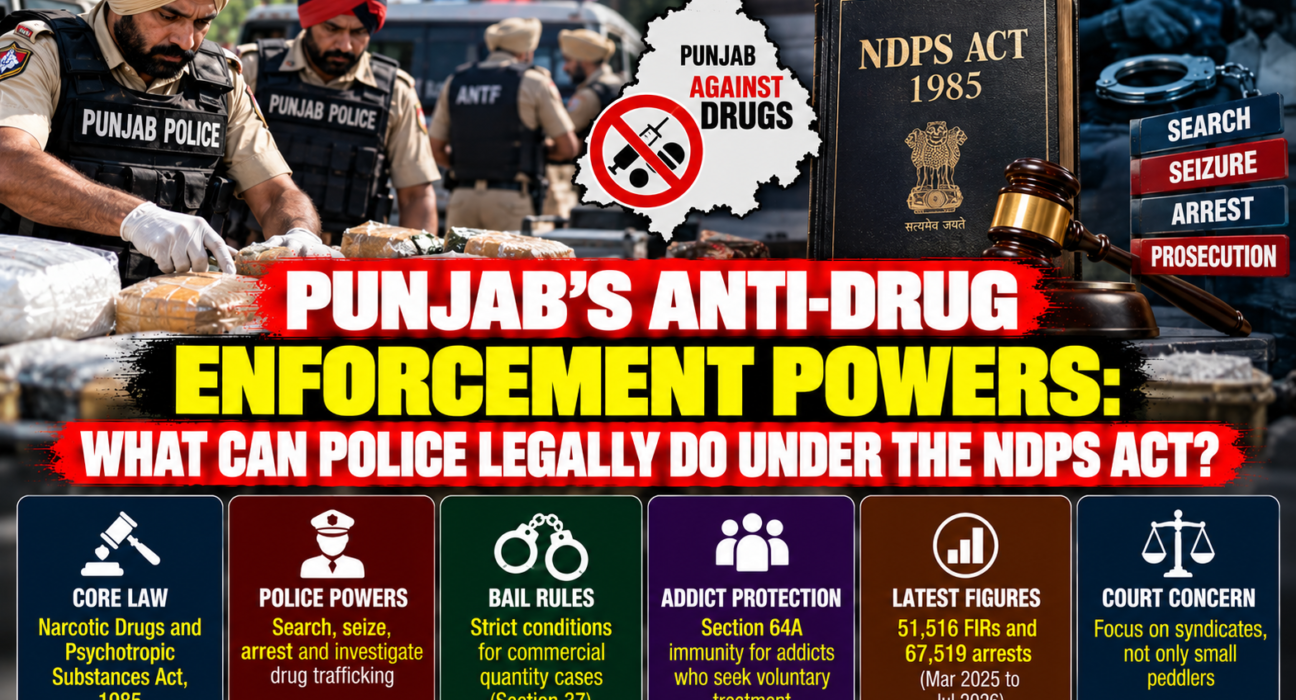
Punjab’s Anti-Drug Enforcement Powers come mainly from the Central NDPS Act, 1985, which lets police search, seize, arrest and prosecute traffickers, while Section 64A can shield addicts who seek treatment. Punjab Lens Media notes that powers are strong but bound by procedure and court oversight.
Key Takeaways
| Area | What it means |
| Core law | Narcotic Drugs and Psychotropic Substances Act, 1985 |
| Police powers | Search, seizure, arrest, investigation of trafficking |
| Bail | Strict conditions for commercial-quantity cases (Section 37) |
| Addict protection | Section 64A immunity for voluntary treatment |
| Scale (Mar 2025 to Jul 2026) | 51,516 FIRs and 67,519 arrests |
| Court concern | Focus on syndicates, not only small peddlers |
What Are Punjab’s Anti-Drug Enforcement Powers?
Punjab’s Anti-Drug Enforcement Powers are not unique state laws; they operate through the NDPS Act, backed by state police units such as the Anti-Narcotics Task Force. The Punjab government anti-drug enforcement authority sets strategy, while the Punjab police powers in drug cases are defined by the Act and the Code of Criminal Procedure. Punjab Lens Media explains the framework so readers know their rights.
What Can Police Do Under Punjab NDPS Act Enforcement?
Under Punjab NDPS Act enforcement, officers can search premises, vehicles and persons on credible information, seize contraband, arrest suspects and register FIRs. The Act requires safeguards, such as giving a suspect the option of search before a gazetted officer or magistrate. In the Punjab police drug investigation powers context, procedural mistakes can cause cases to collapse in court. This is a central theme in every report on Punjab narcotics enforcement laws by Punjab Lens Media.
Are the Legal Powers Against Drug Smugglers in Punjab Too Strict or Too Weak?
Critics and courts disagree. A 2018 Vidhi Centre study of 13,350 Punjab judgments argued that strict liability produced many convictions that were not about traffickers. In May 2026 the Supreme Court reportedly criticised enforcement that targets small peddlers while influential offenders escape. At the same time, the state says it combines Punjab drug trafficking enforcement measures with rehabilitation, including immunity for more than 10,000 addicts. For legal powers against drug smugglers in Punjab, Punjab Lens Media suggests reading arrests alongside conviction data.
What Does the Latest NDPS Act Punjab News Say?
From 1 March 2025 to 6 July 2026, police registered 51,516 NDPS FIRs and arrested 67,519 people, according to reported official figures. That is the headline of the NDPS Act Punjab latest news. The Punjab anti-drug law and policy debate now asks whether higher numbers mean fewer drugs or simply more arrests. Punjab Lens Media will keep tracking Punjab’s Anti-Drug Enforcement Powers as new data appear.
How Should a Citizen Respond If Police Search Them in a Drug Case? (How-To)
- Stay calm and do not resist physically.
- Ask the officer to state the legal basis and request the option of a gazetted officer or magistrate for search.
- Ask for a copy of the seizure memo and FIR.
- Contact a lawyer or legal aid immediately.
- Follow Punjab Lens Media for explainers on Punjab’s Anti-Drug Enforcement Powers.
FAQ
Q1. What are Punjab’s Anti-Drug Enforcement Powers? Powers under the NDPS Act to search, seize, arrest and prosecute drug offenders, used by Punjab Police. Punjab Lens Media explains Punjab’s Anti-Drug Enforcement Powers with court context.
Q2. Can addicts avoid prosecution? Section 64A can give immunity to addicts who voluntarily undergo treatment.
Q3. Is bail easy in NDPS cases? Not for commercial quantity; Section 37 sets strict conditions.
Q4. Where can I read more on Punjab’s Anti-Drug Enforcement Powers? Follow Punjab Lens Media for every update on Punjab’s Anti-Drug Enforcement Powers.
Conclusion
Punjab’s Anti-Drug Enforcement Powers are broad but conditional: strong against trafficking, and bound by legal safeguards and judicial review. This is general information, not legal advice. Keep following Punjab Lens Media for clear coverage of Punjab’s Anti-Drug Enforcement Powers.